From emergency plan to an audit-ready BCMS — without double work
Why “covered” doesn't mean “evidenced”, and how a data model instead of loose document files keeps your continuity concept standing up in an audit.
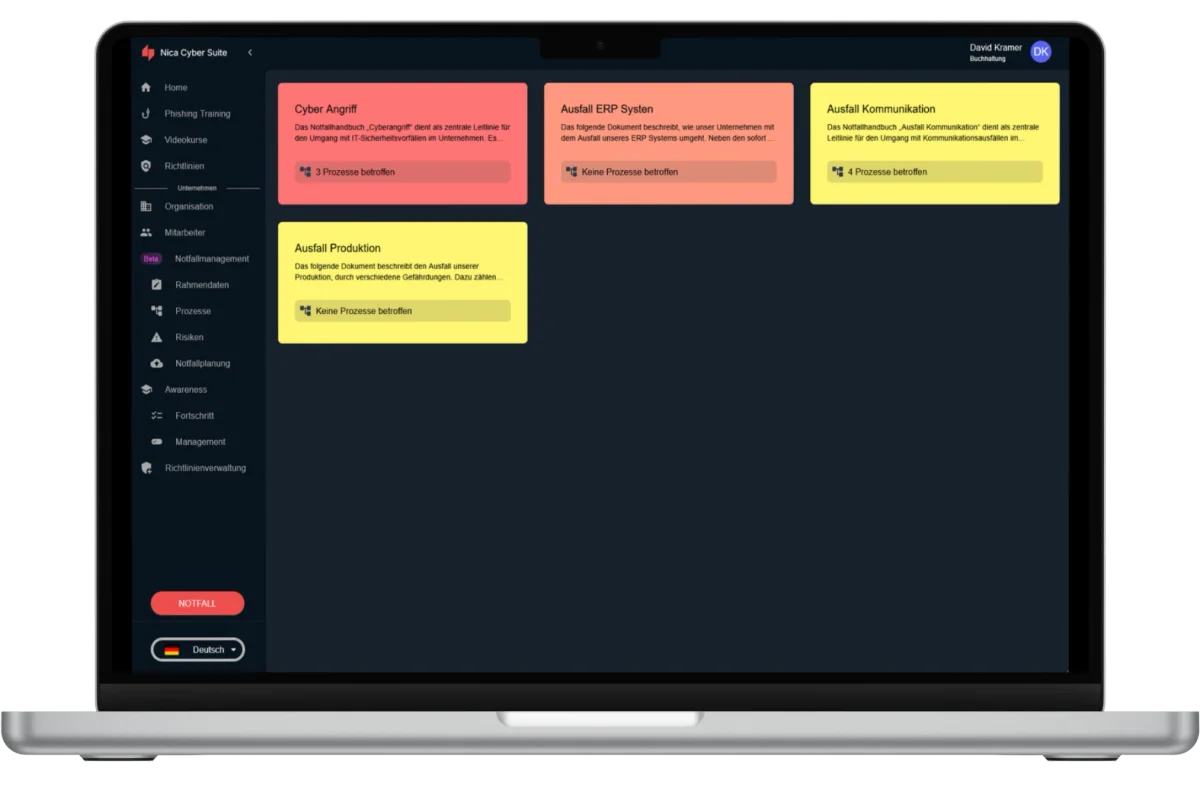
Almost every organisation has an emergency plan “somewhere”. The audit then often reveals the problem: documents contradict each other, recovery times exist in three versions, and no one can prove the content is current. Having a document is not the same as being able to prove something.
The data model is the source
The core of a robust business-continuity management is not the document template but a structured data base. Processes, dependencies, risks and recovery metrics are maintained once — every document is derived from it. Change a recovery time and it changes everywhere.
Consistency can't be produced by copy-paste. It emerges when every statement has exactly one source.
Maturity levels, not a mega-project
No one has to begin with the full management system. The reactive entry — a robust emergency manual — is achievable in a manageable time. From it grows, without data loss, integrated BCM and finally the audit-ready system aligned with BSI 200-4 and ISO 22301.
Audit-ready, not “certified”
An honest note: software brings you into the audit-ready state and produces the necessary evidence — formal certification is done by an accredited body. That very honesty is worth gold in an audit: gaps are named, not hidden.
Related from our offering
Keep reading
 AI-generated image
Emergency or crisis? Why the distinction decides your response
Server-room fire at 3 a.m.: emergency or crisis? Separating the two terms cleanly means alerting the right people, escalating in time — and preventing a manageable incident from becoming an existential threat.
 AI-generated image
5 common mistakes in emergency planning — and how to avoid them
Perfect on paper, useless when it counts: why emergency plans fail on vague instructions, missing upkeep, IT tunnel vision, untrained roles and slow alerting — with practical examples and concrete remedies.