BCM software: business continuity management with NICA BCM — aligned with BSI Standard 200-4 and ISO 22301
Business continuity management has not been a side issue since 2020 at the latest. Anyone who wants to stay able to act in an emergency needs a clear framework — and the right tools. This article explains why structured emergency preparedness is necessary, which standards set the framework and how NICA BCM supports companies in putting it into practice.

Introduction: why BCM software is indispensable today
The coronavirus pandemic, disrupted supply chains, the energy crisis and the ransomware waves of 2023/2024 have repeatedly put companies in the DACH region in situations they were not prepared for. According to a representative ZEW survey (opens in a new tab) (December 2025/January 2026, around 1,100 companies), 9% of companies in the information economy and 7% in manufacturing suffered downtime from cyberattacks in 2025. The July 2021 floods in Western and Central Europe caused damage running into billions (opens in a new tab) in Germany alone. Natural events like these, IT outages and cyberattacks show: business continuity management (BCM) aims to keep critical business processes running, and without structured tools that aim remains abstract.
Scattered individual documents reach their limits in regulated or complex organisations: version conflicts, a lack of traceability, no automatic update when something changes. BCM software helps companies keep critical business processes running in an emergency by linking processes, risks and measures in one place. For organisations that fall under NIS2 or work to ISO 27001 or BSI Standard 200-4, specialised software is an obvious choice.
What is business continuity management (BCM), and what role does the BIA play?
Business continuity management is a management system designed to keep critical business processes going during and after crises. It covers analysis, planning, implementation, testing and continual improvement. The core building blocks of a business continuity management system are:
- Business impact analysis (BIA): identifying and assessing critical processes
- Risk analysis: assessing threats and their impact on the organisation
- Emergency planning: creating emergency plans, recovery strategies and scenarios
- Emergency exercises: regular tests of the plans under realistic conditions
- Continual improvement: adjustments based on exercise results and changing risks
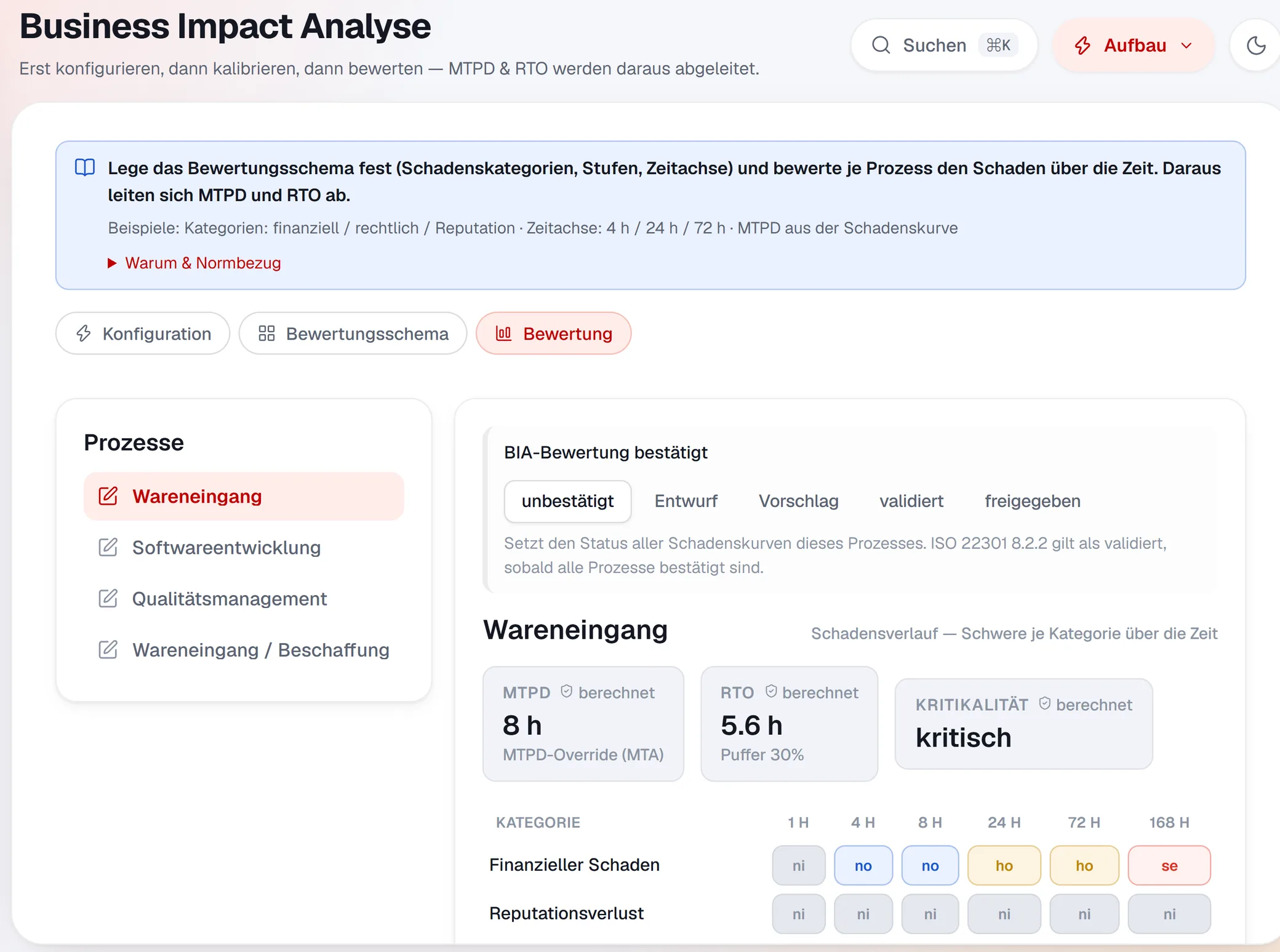
The business impact analysis is decisive for emergency planning and forms the basis for emergency plans in BCM. A BIA identifies business-critical processes and risks, assesses the consequences of business interruptions and sets recovery times. The RTO (recovery time objective) states by when a process should be running again; the maximum tolerable downtime is called the MTPD. RPO stands for recovery point objective and refers to the maximum tolerable data loss. RTO and RPO determine how quickly, and with how much data loss, a process has to be restored after a disruption.
For mid-sized companies and critical infrastructure operators, the BIA is decisive for resilience: limited resources and a heavy dependence on a few core processes make a structured analysis indispensable. Standards such as ISO 27001 call for information security during disruption and for ICT continuity; the BIA is the usual basis for both. Anyone who carries it out informally or not at all risks wrong priorities and audit findings.
BCM software: definition, benefits and typical use cases
BCM software refers to specialised tools for planning, documenting and steering all BCM activities. It supports the entire business continuity management life cycle and provides a central data basis for processes, responsibilities, dependencies and measures.
Core benefits at a glance:
- Transparency: a complete view of business processes, IT systems, resources and their dependencies
- One shared basis: all data in one place instead of scattered across many individual files
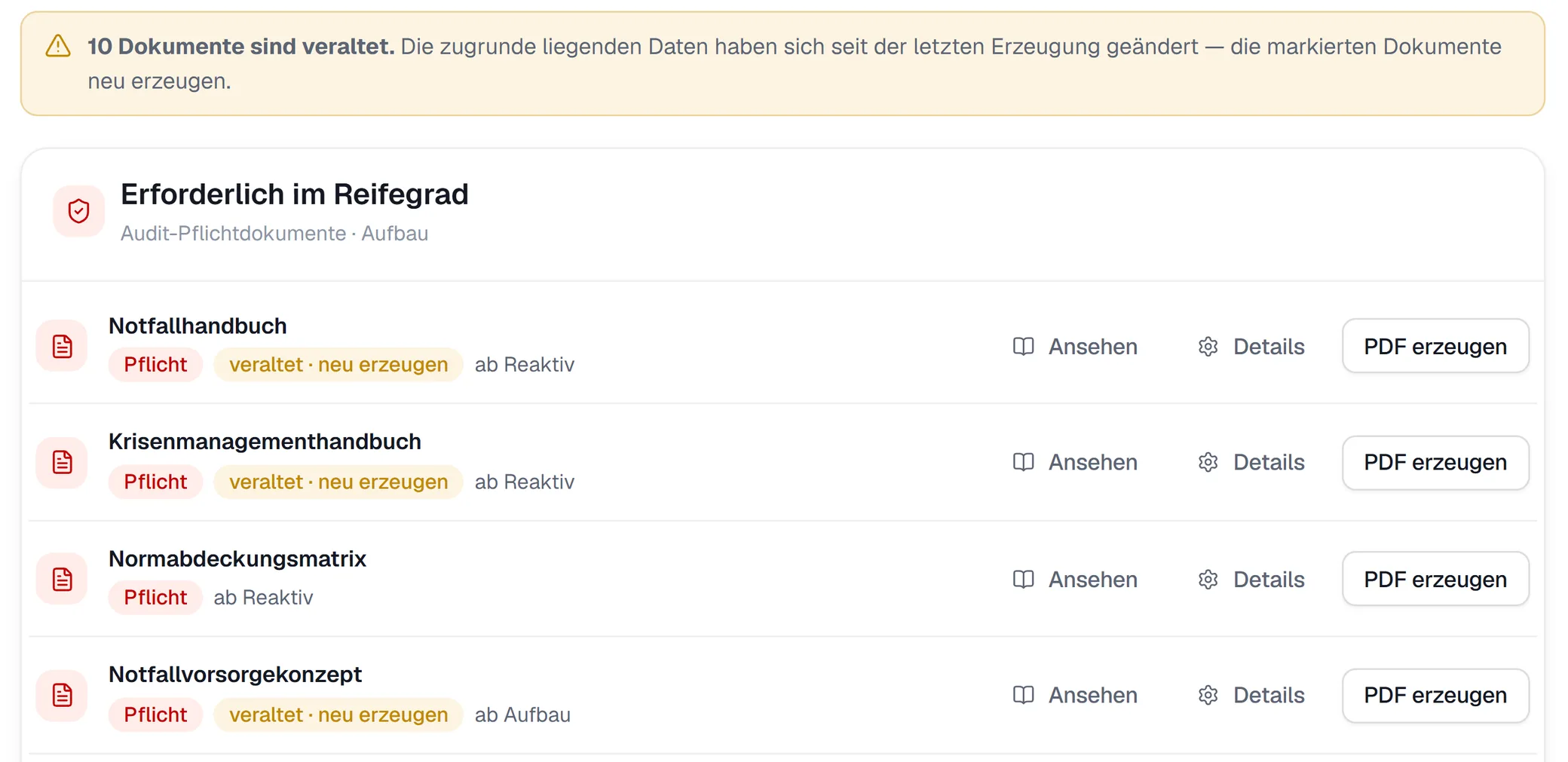
- Automated documentation: emergency manuals, recovery plans and standards coverage matrices are generated from the data basis
- Audit readiness: BCM software can version documents and track measures; every change is traceable
BCM software supports the structured implementation of all BCM processes and can be deployed on-premises or as a SaaS solution. Emergency and recovery planning includes creating and maintaining emergency plans based on real BIA data.
Typical use cases include companies affected by NIS2, ISO 27001-certified organisations, institutions with IT-Grundschutz requirements and regulated sectors such as finance, healthcare and energy supply. Anyone who maintains BCM in scattered individual documents struggles with missing versioning, manual upkeep and the risk of standing out in an audit with inconsistent data. Modern BCM software covers classic emergency planning, crisis management and compliance reporting in one tool.
Norms and standards: BSI Standard 200-4, IT-Grundschutz, ISO 22301 and ISO 27001
Compliance is one of the main drivers for introducing BCM software. Four standards shape the framework in the DACH region.
BSI Standard 200-4 (published in its final version in 2023) is the leading German standard for setting up emergency management. It defines three maturity levels for a business continuity management system (opens in a new tab) (German): reactive BCMS (emergency plan, reporting channels), build-up BCMS (BIA, risk analysis, strategies) and standard BCMS (a complete system with policy, key figures, exercise programme and management review). The standard applies the PDCA cycle across all levels.
IT-Grundschutz: in the IT-Grundschutz Compendium, module DER.4 (emergency management) describes what structured emergency management involves. Regular tests and exercises are necessary for effective BCM; missing evidence of exercises can lead to findings in audits.
ISO 22301 is the international standard for business continuity management (opens in a new tab). It sets out how a BCMS is to be built, how risk assessment and BIA are to be carried out and which strategies for keeping the business going have to be defined.
ISO 27001 overlaps with BCM above all through controls A.5.29 (information security during disruption) and A.5.30 (ICT readiness for business continuity) of the 2022 edition.
NICA BCM is aligned with BSI Standard 200-4, ISO 22301 and the requirements of ISO 27001; the following sections show how.
NICA BCM at a glance: central information management for business continuity
With NICA BCM we provide BCM software that brings business impact analysis, risk analysis and emergency planning together in one integrated data model. The key features:
- Single source of truth: one shared data basis for processes, resources, risks and measures. BIA values such as MTPD and RTO are derived from this basis; when something changes, derived documents are marked as outdated and can be regenerated from the same data.
- Integrated data model: business impact analysis, risk analysis and emergency planning draw on the same master data; nothing is maintained twice.
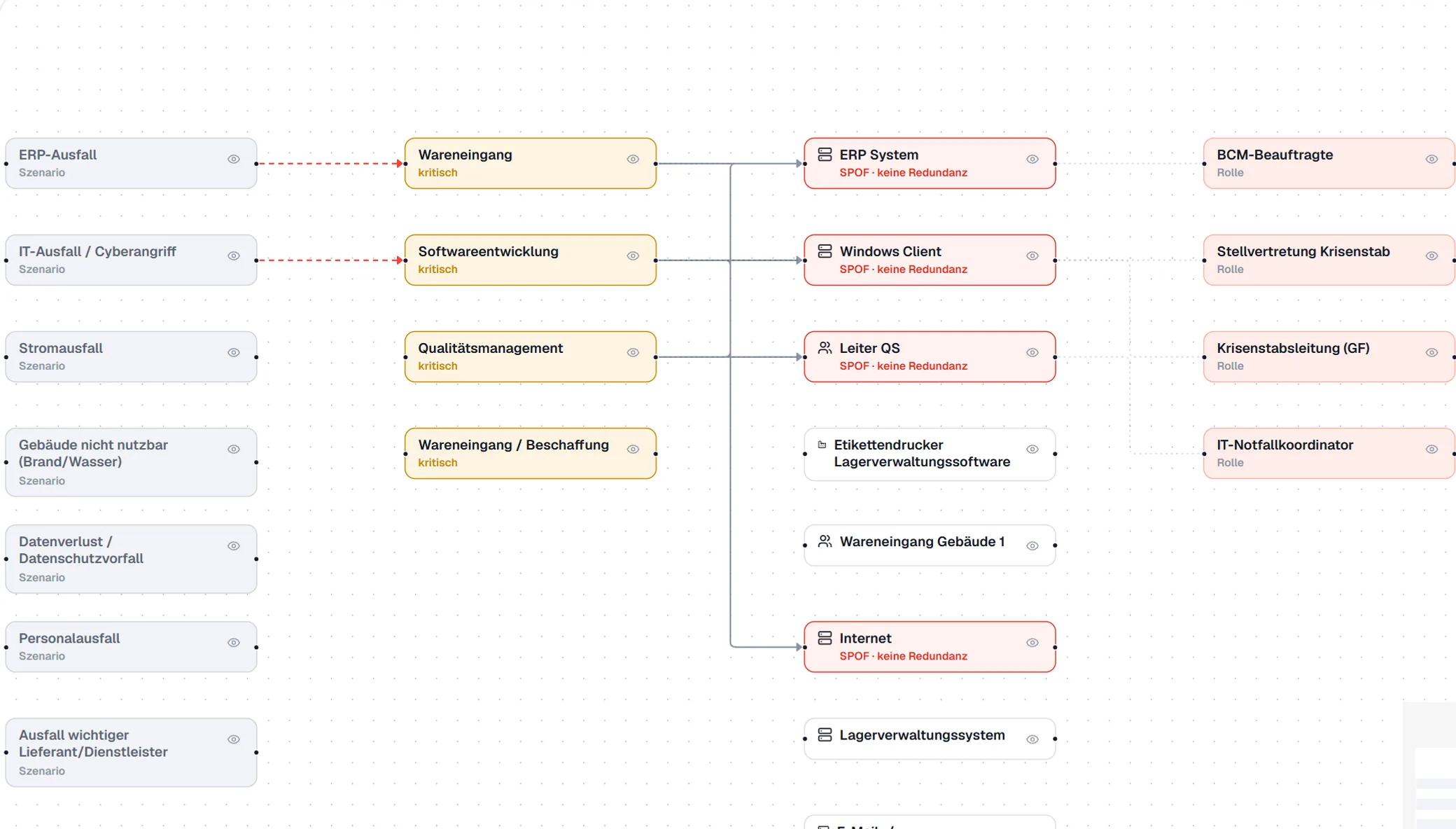
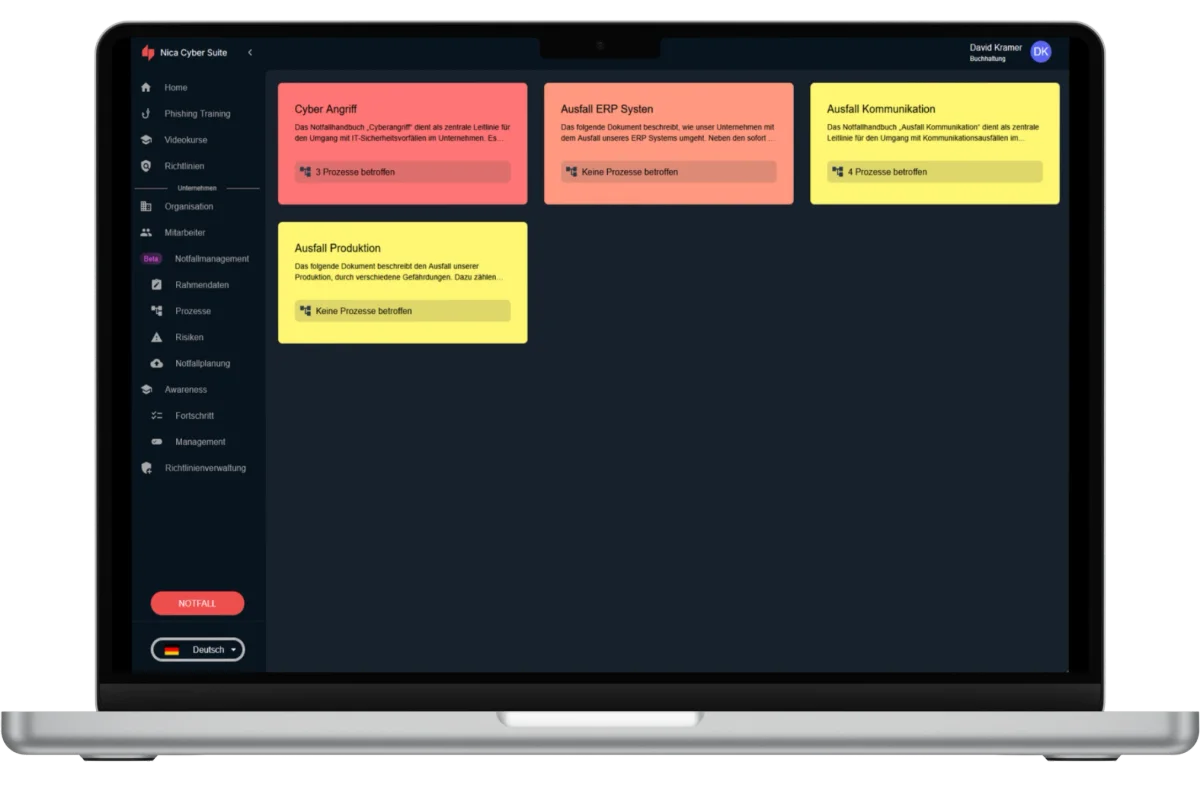
- Visualised dependencies: dependency graphs show the links between scenarios, business processes and resources such as IT systems, buildings, roles and external service providers.
- German-language: interface and documents in German, hosted in German data centres.
NICA BCM reflects the three levels of BSI Standard 200-4 directly in its structure and supports organisations on the way to certification to ISO 22301 or ISO 27001; certification itself is carried out independently.
You can request a demo or a consultation on the product page.
Business impact analysis (BIA), risk and emergency planning with NICA BCM
NICA BCM covers the entire BCM life cycle, from analysis through planning to exercises. At its centre is the link between BIA data, emergency plans and measures.
Business impact analysis in NICA BCM:
- Structured capture of business processes with attributes such as criticality, maximum tolerable period of disruption (MTPD) and recovery objectives (RTO/RPO)
- Process owners are involved through guided questionnaires
- Automatic prioritisation and classification of critical processes based on the BIA data
Risk assessment and action planning:
- Risks are assigned to processes and resources
- Risk and threat analyses assess potential threats and their impact; the assessment is based on likelihood and impact
- Optional: reference to information security risks (e.g. from ISO 27001)
- Planning and tracking of measures, including responsibilities, due dates and status
Emergency and recovery planning:
- Emergency plans and recovery strategies derived directly from BIA and risk data
- Scenarios such as IT failure, loss of a building, staff shortage or supplier failure are covered
- To alert the crisis team, NICA BCM can be combined with the NICA alerting app. Roles and deputies in the crisis team are set out bindingly.
- The crisis organisation comprises the crisis team and the situation centre; alerting and communication chains are clearly defined in the procedure
Automated documents, standards coverage and audit preparation with NICA BCM
Audit pressure is rising: ISO 22301 certifications, ISO 27001 audits, internal audits and supervisory authorities expect traceable, consistent evidence. NICA BCM generates this documentation automatically from the central data basis.
Generated documents:
- Emergency manual and crisis management manual in German
- Process and recovery overviews for business units, IT and management
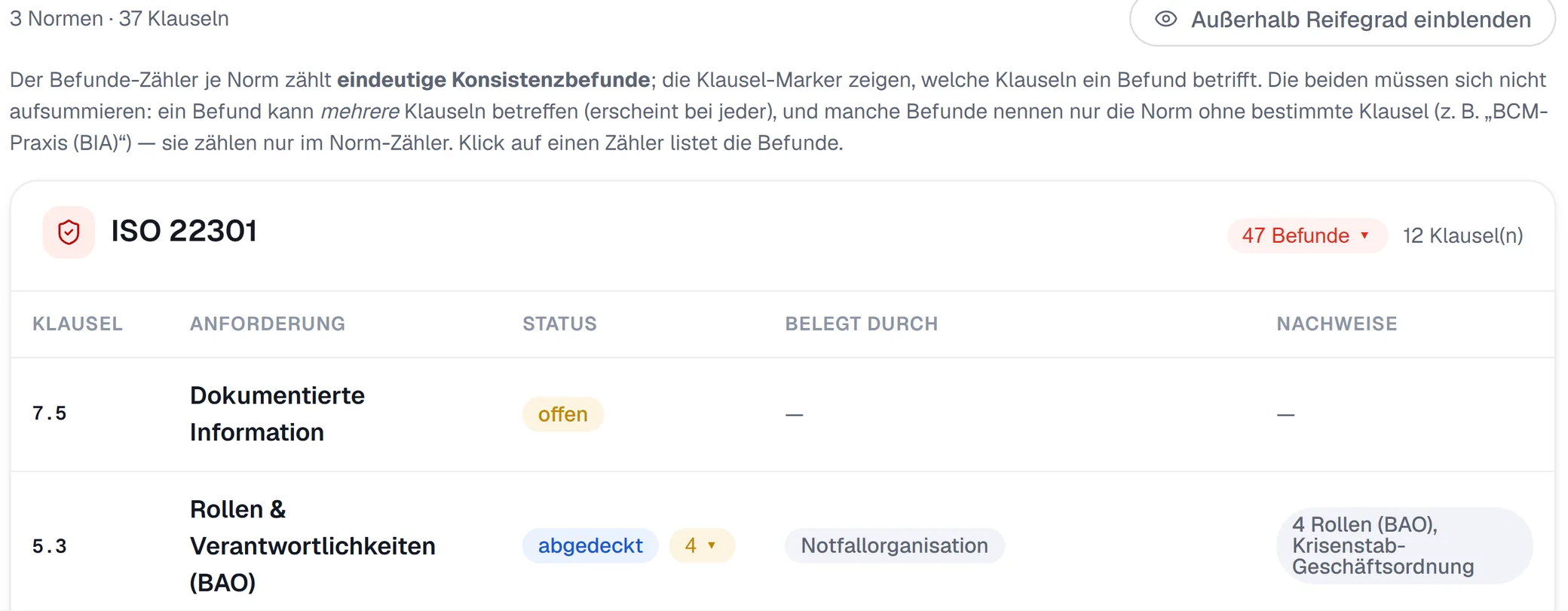
- Standards coverage matrix for BSI Standard 200-4 and ISO 22301, showing which requirements are covered by which elements
Audit readiness:
- Versioning and traceable approvals of documents
- Clear assignment of responsibilities and approvals to processes, risks and measures
- A dashboard shows the state of the BCM within the chosen maturity level
- PDF export for direct use in audits and management reports
- Exercise and test management supports running crisis exercises and evaluating them
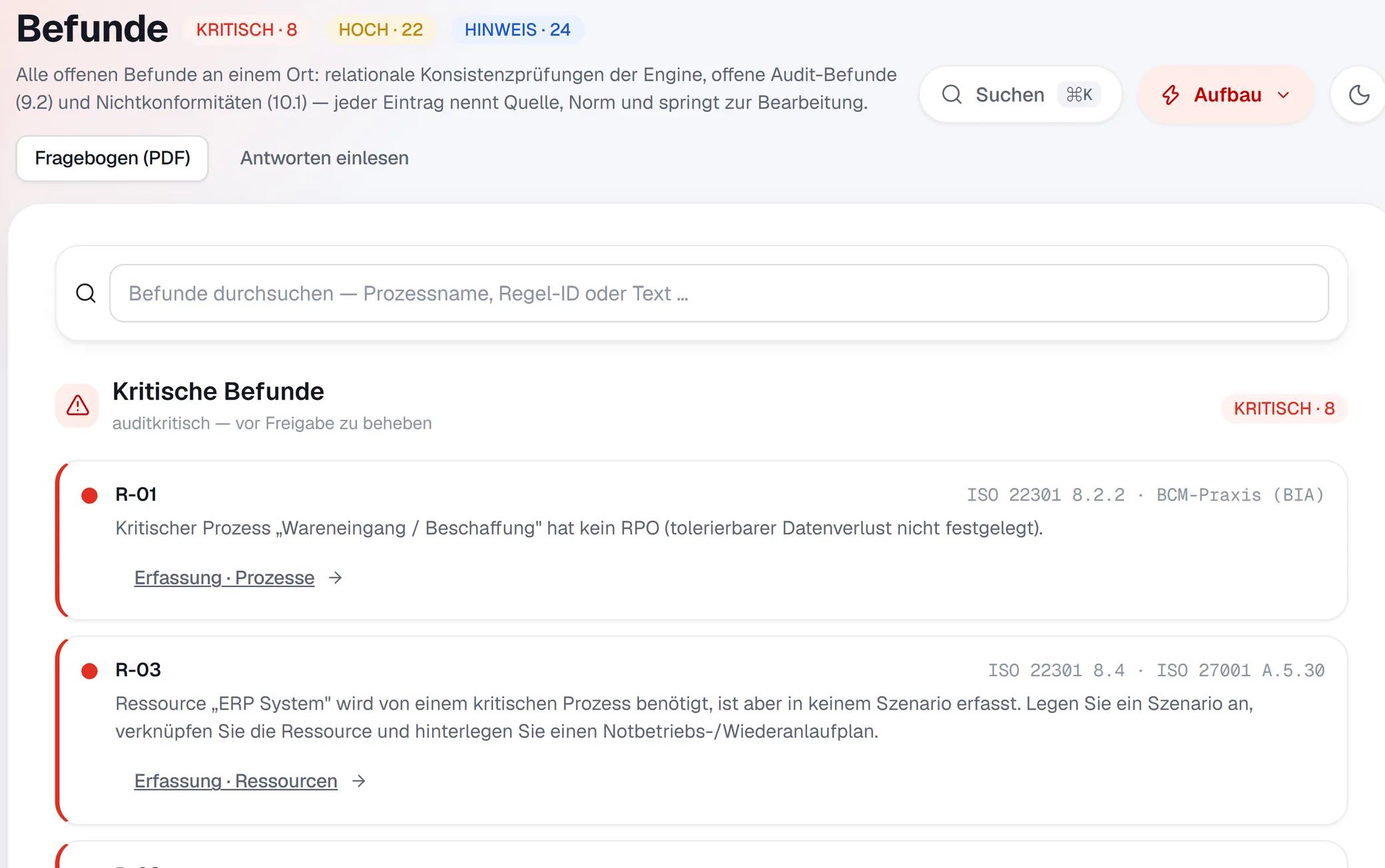
NICA BCM supports audit preparation with consistent, traceable evidence; certification is carried out independently. Findings are checked in the background; each finding states the relevant standard and jumps to the affected place in the system.
Maturity model and introduction: how we support your path to BCM
NICA BCM follows the maturity model of BSI Standard 200-4 and allows a modular start without the effort of a full-scale rollout.
- Reactive: you capture the most important processes and dependencies, define reporting channels and create basic emergency plans. Output: emergency manual, crisis management manual, alert cards. Aim: the ability to act at short notice in an emergency.
- Build-up: you carry out a detailed business impact analysis, structure your risk analysis and create robust emergency documentation with business continuity plans and recovery plans.
- Standard: connection with an ISMS to ISO 27001. NICA BCM provides this connection as part of the standard maturity level, with policy, objectives and key figures, exercise concept and management review. Regular exercises are needed to improve crisis management and are planned and evaluated systematically in this phase.
NICA BCM suits mid-sized companies as well as large, regulated organisations. You start along your existing structures; everything you capture in the reactive phase flows seamlessly into the build-up and standard phases, without data migration.
Would you like to assess where you stand and plan the right way in? Arrange a no-obligation initial meeting or a live demo via our product page.
Conclusion and next steps: building resilience and preparing for audits with NICA BCM
BCM is both an obligation and an opportunity. Standards such as BSI Standard 200-4, ISO 22301, ISO 27001 and IT-Grundschutz define concrete requirements for analysing, protecting and recovering critical processes. With specialised BCM software, these requirements become everyday practice instead of paperwork. The business impact analysis (BIA) is the central building block at the start of every working emergency concept.
NICA BCM brings business impact analysis, risk analysis and emergency planning together in one system on a shared data basis. Interface and documents in German, hosted in German data centres: a German-language solution for organisations that want to combine compliance with the ability to act.
Next steps:
- Visit the NICA BCM product page for details on features and scenarios
- Request a demo or a workshop on introducing business continuity management (BCM) with NICA BCM
- Start early with a structured business impact analysis to tackle requirements from NIS2, ISO 27001, ISO 22301 and BSI Standard 200-4 in a targeted way
Related from our offering
Keep reading
 AI-generated image
BCM: the key to effective business continuity in times of crisis
What business continuity management achieves, how a business impact analysis works and what belongs in a business continuity plan — with a view to ISO 22301 and mid-sized companies.
 AI-generated image
From emergency plan to an audit-ready BCMS — without double work
Why “covered” doesn't mean “evidenced”, and how a data model instead of loose document files keeps your continuity concept standing up in an audit.