Use cases for alerting apps at schools — mastering typical emergencies
Lockdown, fire, medical emergency, suspicious activity: four typical scenarios where an alarm app makes the decisive difference — with targeted information instead of a one-size-fits-all signal.
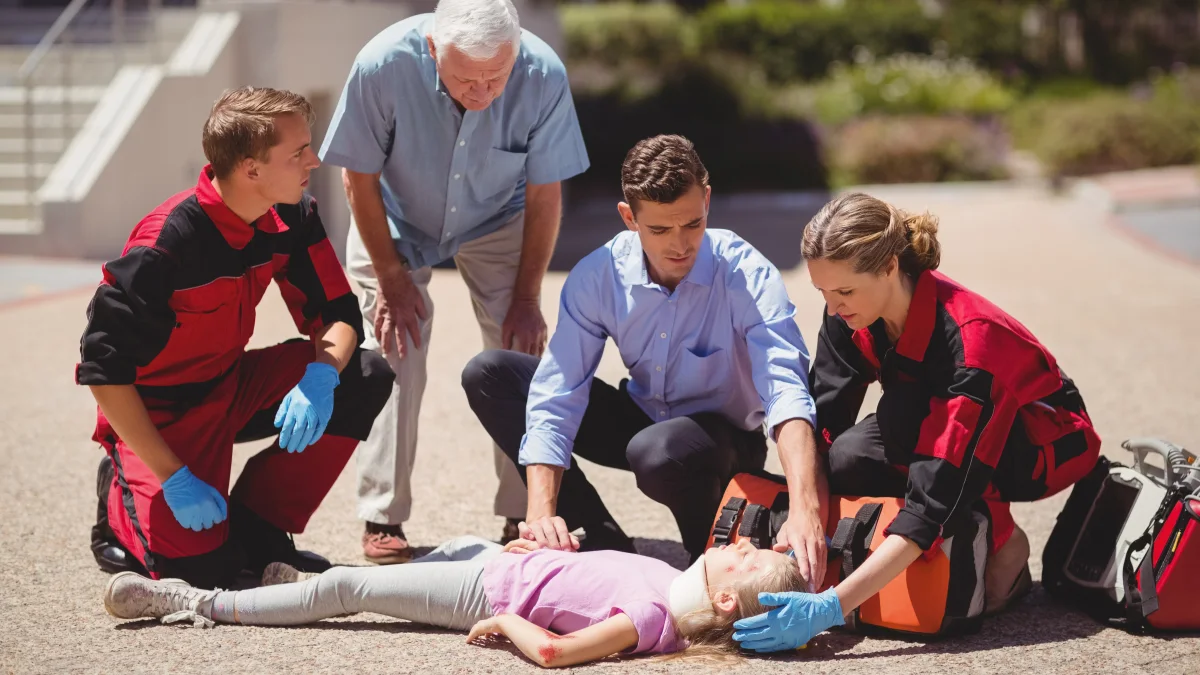
A sudden fire, a medical emergency or the most threatening situation of all — an active-shooter incident: schools must be prepared for emergencies. Yet many institutions still rely on announcements or bell signals — often unspecific, unsettling and without targeted information. Digital alerting enables immediate, structured communication — the fundamentals are in our overview of alerting apps. Here we show four typical scenarios where an alarm app makes the decisive difference.
Scenario 1: Lockdown
Active-shooter situations are unpredictable and highly volatile — speed and clarity are vital. Loudspeaker announcements or bell signals often aren't enough: too many people don't know how to behave. With the app, a lockdown is declared immediately and precisely: teachers receive direct instructions via push notification, secure rooms, lock doors — and report back in real time who was reached and who needs support.
Scenario 2: Fire / evacuation
Standard fire alarms often sound like break bells — and not every teacher knows which assembly point applies in which situation. The “evacuation” scenario sends a clear text message with a visual assembly-point map to all relevant groups: “Leave the building via exit B”, “Assembly point: sports field”. That creates clarity where confusion would otherwise reign.
Scenario 3: Medical emergency / first-aider alerting
With injuries every minute counts — but it's often unclear which first aiders are available. Instead of shouting through the building, the app informs the first-aider group precisely: the message reaches only the relevant people, acknowledgements like “on my way” provide coordination and reassurance. The school administration is informed in parallel.
Scenario 4: Suspicious activity / heightened alert
With diffuse threats — a suspicious person in the schoolyard, an anonymous letter — a quiet communication channel is often missing: a fire alarm would be excessive, silence can be dangerous. The “heightened alert” scenario informs only teachers and safety officers: “Please stay in your classroom until further notice.” Panic is avoided without reducing readiness.
Instead of a one-size-fits-all signal, scenarios offer targeted addressing, information and coordination — the right response for every situation.
The four scenarios at a glance
| Scenario | Who is informed | Core function |
|---|---|---|
| Lockdown | All teachers & crisis team | Instant lockdown with instructions & real-time acknowledgement |
| Fire / evacuation | All relevant groups | Text message + visual assembly-point map |
| Medical emergency | First-aider group only | Targeted notification with “on my way” acknowledgement |
| Heightened alert | Teachers / safety officers only | Quiet alerting without panic |
Common questions
- Which scenarios does an alarm app cover? Typical are lockdown, fire/evacuation, medical emergencies (first aiders) and suspicious activity with heightened alert.
- How do the alarms differ? Every scenario has its own texts, groups, escalations and acknowledgement functions — adapted to the situation.
- How does acknowledgement work? With one tap (“I'm safe”, “help needed”) — visible in the dashboard in real time.
- Who manages the scenarios? The school itself, via the web dashboard — no IT skills required.
Bottom line: safety needs scenarios. For how the rollout works at your school — from trial access to go-live — see our step-by-step guide. More on the solution: alerting app for schools and emergency plans for education & the public sector — or get in touch.
Related from our offering
Keep reading
 AI-generated image
Emergency or crisis? Why the distinction decides your response
Server-room fire at 3 a.m.: emergency or crisis? Separating the two terms cleanly means alerting the right people, escalating in time — and preventing a manageable incident from becoming an existential threat.
 AI-generated image
5 common mistakes in emergency planning — and how to avoid them
Perfect on paper, useless when it counts: why emergency plans fail on vague instructions, missing upkeep, IT tunnel vision, untrained roles and slow alerting — with practical examples and concrete remedies.